
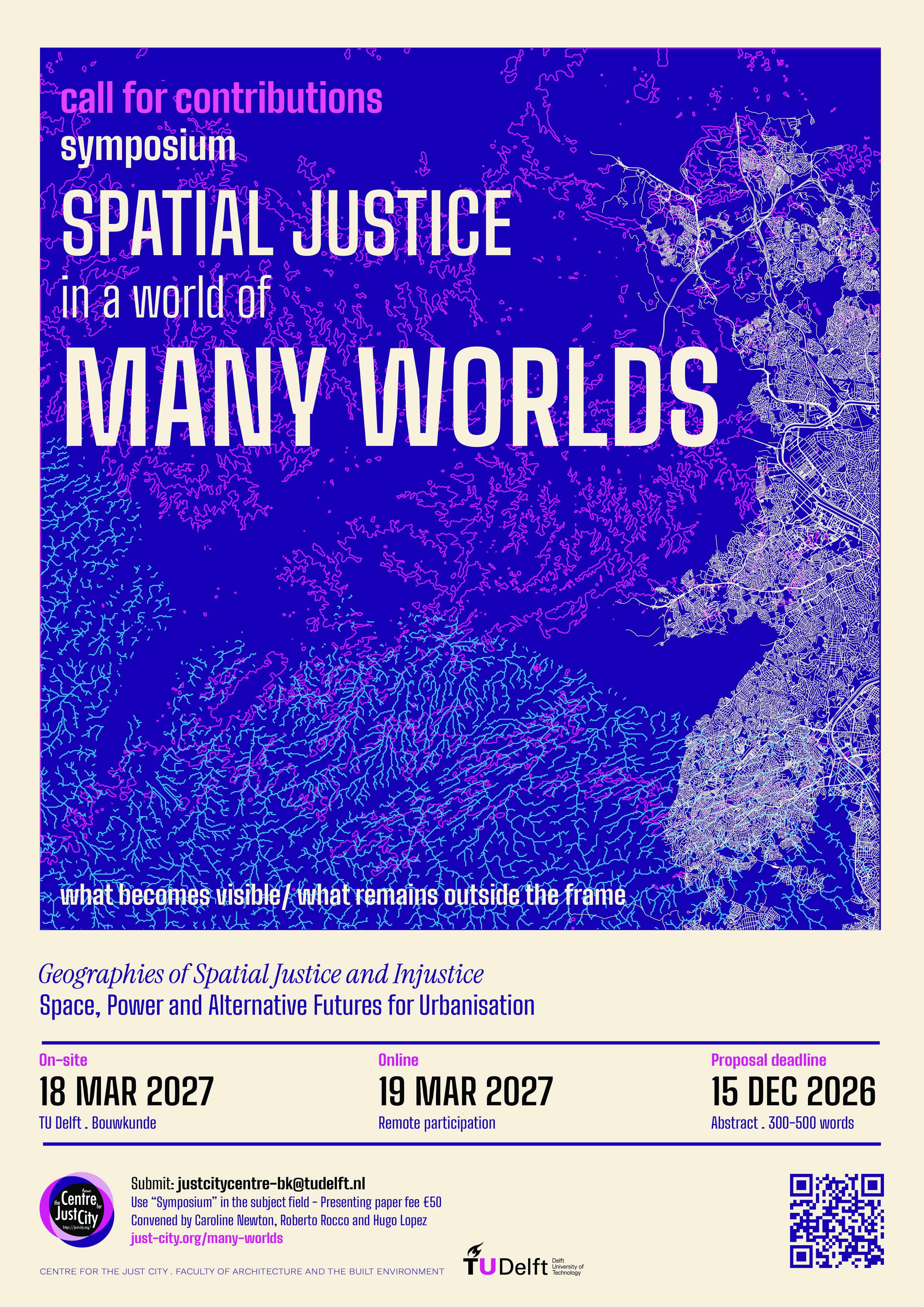
call for contributions
symposium
Spatial Justicein a world ofMany Worlds
Spatial planning is not neutral. Its maps, classifications and procedures make some people, places, relations and futures visible, and leave others out. Planning shapes space around the needs and wishes of those it sees, leaving the rest behind. Every ontology carries its own sense of what a place is, who belongs to it, and what justice requires within it. Different ontologies produce different epistemologies: different ways of knowing follow from different ways of being. This symposium asks how we work with these plural accounts of reality. It wants to give space to the different ontologies, and to the conversation between them.

Riverbank soundscape, Lingewal, Huissen, 17 June 2026 (21:03) · Joost van Bruggen, XC1146856, xeno-canto.org · CC BY-NC-ND 4.0
A river is never just water.
Spatial planning does more than organise land uses and coordinate development. Through maps, classifications and procedures, it makes some people, places, relations and futures visible while leaving others outside the frame of public action. In doing so, it shapes what can be governed, whose claims count and which forms of life can endure. A river, for example, may enter planning as a resource or legal object. It may also exist as a living ancestor or a relation of collective life. These are not always rival interpretations of an otherwise settled thing. They may be different spatial realities, sustained through different practices and carrying different obligations. The conflict becomes unjust when only one of these realities has the institutional authority to shape maps, licences, property rights, compensation and repair, while the others must translate themselves into its terms.
This symposium invites theoretically ambitious and empirically grounded contributions on spatial injustices and justices across diverse ontologies, and on how they are understood across different geographies. The symposium will serve as both a forum for collective argument and a formative stage in developing the edited volume with the working title Geographies of Spatial Justice and Injustice. Our aim is not to assemble a catalogue of cultural perspectives on space. Instead, we examine how worlds are materially made, how some accounts acquire institutional authority over others, how people negotiate or refuse that authority, and what justice requires in response.
Justice after the object is settled.
Spatial justice begins with a powerful insight: space is made and remade through institutions, capital, law, political struggle and everyday life. Once we understand space in these terms, questions about who receives resources and bears risks, who participates in decisions, and whose identities and ways of life are recognised become central to spatial planning and analysis. The Centre for the Just City brings these concerns together in its Spatial Justice model: fair recognition, fair process and fair distribution provide three connected lenses through which justice claims can be evaluated.
The model remains indispensable, but it can enter the argument too late. By the time we ask whether recognition, process and distribution are fair, the entities, subjects and scales of justice may already have been defined. Land may already have become property, a river a resource, the city a bounded administrative object, and nature an external domain to be protected or exploited. People can then contest ownership, use, meaning or value, while one modern account of reality continues to determine what the dispute is about.
Colonial modernity refers here to the unequal power to make one world institutionally real. Property law, zoning, maps, cadastres and professional expertise do more than order and govern territories. They help determine what territory is, which relations within it become visible, and whose account of it can acquire legal and political authority. Other worlds have not disappeared. They persist through adaptation, resistance, refusal and uneasy coexistence. The challenge for spatial justice is both to explain how their subordination is reproduced and to identify what repair would require of land relations, authority, institutions and knowledge.
Epistemic plurality is not ontological plurality.
The distinction between epistemic and ontological plurality is central to the symposium.
Epistemic plurality
Recognises that differently situated people may know a shared reality in different ways.
Ontological plurality
Asks a more difficult question: whether ways of knowing and living may also involve partly different realities.
The boundary between the two is not clear-cut, since knowing and being cannot be neatly separated. Yet the distinction changes the political stakes. A planning process may invite Indigenous or local knowledge while continuing to assume that the river, forest or territory in question is ultimately the same object for everyone. Voice is broadened, but the reality upon which planning is authorised to act remains unchanged.
Our use of the pluriverse does not imagine worlds as sealed cosmologies, nor does it place every claim beyond judgement. Worlds are historical, contested from within and materially entangled with one another. Practices defended in the name of a local ontology may reproduce gendered, racialised, class and generational hierarchies. Scholars can also romanticise communities, separate ontological difference from the political economy of exploitation, or appropriate Indigenous thought. Taking the pluriverse seriously therefore requires critique across worlds. It also requires us to examine the position from which judgement is made, so that no single world can present its own categories as neutral or universally binding.
“Pluriversal spatial justice seeks the material, political and ontological conditions under which different worlds can sustain themselves, contest the terms of their relations and negotiate shared problems without any one world assuming the authority to define or contain the others.”
This proposition extends rather than displaces distributive, procedural and recognitional accounts of justice. It asks how the objects and subjects among which goods, voice and status are allocated came to count as real, and adds reparation because present encounters begin within histories of dispossession, enclosure and world destruction.
Test, refine, reject or replace this typology.
The position paper prepared for this symposium proposes four connected forms. We invite contributors to test, refine, reject or replace this typology through their cases and arguments. Click each term for what it makes visible.
Foreclosure
The decision is already made before anyone is consulted. Institutions decide what a river, a forest or a territory counts as, and what can be done with it, long before the people who live with the consequences get a say.
In practice
Rickard and Ludwig (2024, 2025) trace how, between late 2021 and the end of 2022, Brazil’s National Water Agency commissioned the consultancy Engecorps to run participatory workshops classifying water bodies across the Doce river basin, working through the Federal Doce River Basin Committee, the state Suaçuí River Basin Committee and the Minas Gerais Institute for Water Management. The classification categories structuring those workshops were set by national water law before any meeting was convened, and admitted the Krenak people only through a single procedural slot: the obligation to register Indigenous territories as Class 1 water bodies. Watú, the living relative the Krenak understand the river to be, entered no part of the agenda.
Forced translation
A community’s claim is heard only once it has been repackaged into terms the system already accepts. A river treated as kin has to be relabelled as a cultural tradition, or a spiritual belief, before officials will take it seriously.
In practice
Blaser (2009) traces this among the Yshiro people of northern Paraguay. When Paraguay’s National Parks Directorate set up a sustainable hunting programme in 1999 with the EU-funded Prodechaco project, the Yshiro federation demanded exclusive rights to broker access between hunters and export buyers, a demand rooted in their obligations to the Yrmo, the network of reciprocal relations that keeps game available. Officials could recognise that demand only once it had been reframed as an economic and managerial claim, a broker’s commission rather than a cosmological obligation. Blaser calls this an uncontrolled equivocation: the programme had room for a commercial interest, not for the relation the Yshiro were actually describing.
Asymmetrical commensuration
Everything is placed on the same scale, usually a price, so that things that were never meant to be compared can be traded against each other. A forest, a sacred site and a construction budget end up on the same balance sheet, and the balance sheet decides which one gives way.
In practice
Ecuador’s Yasuní-ITT Initiative put a price on refusal. In 2007, President Rafael Correa proposed leaving the Ishpingo-Tambococha-Tiputini oil field, inside Yasuní National Park and home to the Waorani and to peoples living in voluntary isolation, permanently unexploited in exchange for 3.6 billion US dollars from the international community, half the field’s estimated market value. The offer placed the rainforest, its biodiversity and the presence of isolated peoples on the same scale as the oil revenue they stood in for (Rival, 2010). By 2012 only 200 million dollars had been pledged; Correa abandoned the initiative in August 2013, and drilling began in 2016. In August 2023, Ecuadorians voted by 67 per cent to ban extraction in the park outright, rejecting the trade the initiative had itself proposed.
World destruction
A physical change on the ground makes an entire way of life impossible to continue. Damming a river or draining a wetland does not just alter the landscape: it removes the conditions a community needs to keep fishing, farming or governing the way it always has.
In practice
On the Xingu River’s Volta Grande, in the Brazilian Amazon, the intervention is measured in cubic metres per second. Average flow through this stretch ran to roughly 12,736 cubic metres per second before the Belo Monte dam began operating in 2015; site monitoring in February 2021 recorded drops to as low as 1,600, after the environmental regulator IBAMA approved the dam operator’s reduced-flow regime that same month. Utsunomiya et al. (2024) trace what that regime does to the neighbouring Arara Indigenous Land: fishing and forest practices tied to the river’s seasonal rhythms degrade as those rhythms are replaced by a regulated discharge. The jurisdiction licensing the dam recognises a flow rate; it does not recognise the relations the Arara built around the flow it replaced.
Five questions organise the discussion.
Five questions will organise the discussion and the developing volume:
- 01
What entities, relations and spatial subjects become real through particular spatial practices?
- 02
Through which histories, institutions and political economies does one spatial ontology acquire authority over others?
- 03
How do affected people negotiate, translate, refuse or transform that authority?
- 04
What distributive, procedural, recognitional, ontological and reparative consequences follow?
- 05
Which institutional arrangements can sustain plurality while enabling decisions about shared and interdependent conditions?
From planning to political ecology.
We welcome work from planning, geography, political ecology, urban studies, Indigenous studies, feminist and Black geographies, decolonial and postcolonial scholarship, legal studies, architecture, anthropology, democratic theory and adjacent fields. Contributions may address, but need not be limited to:
Let the case revise the theory.
Contributions should begin from a grounded spatial conflict, institutional practice or collective project and allow it to revise the terms of the conceptual debate. A strong proposal will:
- Identify the actors, institutions, instruments, histories and material relations through which spatial reality is made.
- Distinguish disagreements over knowledge or value from conflicts that concern what entities and relations exist.
- Connect ontological authority to political economy, law, governance and unequal capacities to act.
- Keep distributive, procedural, recognitional and reparative questions in view.
- Show how affected people adapt, negotiate, resist, refuse or construct alternatives without romanticising them.
- State what the case changes in our understanding of spatial justice, rather than using it only to illustrate an existing framework.
A workshop, not a panel marathon.
The event is envisaged as a workshop-style symposium rather than a sequence of conventional conference panels. A position paper will be circulated in advance to establish a shared but contestable point of departure.
The programme will combine concise paper presentations, thematic roundtables, extended discussion and a closing plenary session. The final format, including possibilities for remote participation, will be communicated with the invitations.
Towards an edited volume.
The symposium will help shape the planned edited volume (working title) Geographies of Spatial Justice and Injustice: Space, Power and Alternative Futures for Urbanisation, edited by Caroline Newton and Roberto Rocco. The book will bring geographically grounded contributions into an argument about how spatial justice changes when the composition of reality itself becomes political.
Selected participants may be invited to develop their papers into chapters after the symposium. Participation in the event will not in itself guarantee inclusion in the volume. Any invitation will remain subject to the book’s conceptual coherence, editorial review and subsequent publication arrangements.
One document, six things.
Please submit one document containing:
- A provisional title.
- An abstract of 300–500 words.
- A short statement of the conceptual contribution to the symposium.
- Up to five keywords.
- A biographical note of no more than 120 words, including institutional affiliation where relevant.
- Three to five indicative references.
- Proposal deadline15 December 2026
- Notification15 January 2027
- Symposium18 March 2027 (on-site) + 19 March 2027 (online)
- How to submitOnline submission form ↗
- Enquiriesjustcitycentre-bk@tudelft.nl
Write “Symposium” in the subject line. - Venue / modeFaculty of Architecture and the Built Environment (Bouwkunde), Julianalaan 134, 2628 BL Delft, the Netherlands, and online
- Participation fee€50 (on-site presenting authors)
Convened by the Centre for the Just City: Caroline Newton, Roberto Rocco and Hugo Lopez.
Where the vocabulary comes from.
The following texts anchor the position paper and the symposium’s initial vocabulary. Contributors are not expected to adopt their arguments.
- Akaabre, P. B. (2025). Ontological locationalities and the pluriversal turn in urban planning: A call to see cities through their own eyes. Dialogues in Urban Research, 3(3), 249–255. https://doi.org/10.1177/27541258251356973
- Arora, S. (2025). Spatial justice beyond today’s colonial modernity. In R. Abughannam (Ed.), Timely reflections on spatial justice (pp. 82–90). CounterWorlds. https://counterworlds.com/timely-reflections/
- Blaser, M. (2009). The threat of the Yrmo: The political ontology of a sustainable hunting program. American Anthropologist, 111(1), 10–20. https://doi.org/10.1111/j.1548-1433.2009.01073.x
- De la Cadena, M., & Blaser, M. (Eds.). (2018). A world of many worlds. Duke University Press. https://doi.org/10.1215/9781478004318
- Escobar, A. (2018). Designs for the pluriverse: Radical interdependence, autonomy, and the making of worlds. Duke University Press. https://doi.org/10.1215/9780822371816
- Rickard, T., & Ludwig, D. (2024). Dam the river: Ontological exclusion in global and Brazilian Integrated Water Resources Management. Environmental Science & Policy, 156, Article 103755. https://doi.org/10.1016/j.envsci.2024.103755
- Rickard, T., & Ludwig, D. (2025). Rivers across worlds: A conceptual framework for ontological inclusion & exclusion in participatory water governance. Environment and Planning E: Nature and Space, 8(1), 251–277. https://doi.org/10.1177/25148486241280157
- Rival, L. (2010). Ecuador’s Yasuní-ITT Initiative: The old and new values of petroleum. Ecological Economics, 70(2), 358–365. https://doi.org/10.1016/j.ecolecon.2010.09.007
- Todd, Z. (2016). An Indigenous feminist’s take on the ontological turn: ‘Ontology’ is just another word for colonialism. Journal of Historical Sociology, 29(1), 4–22. https://doi.org/10.1111/johs.12124
- Utsunomiya, R., Beveridge, C., Lobo, G., Assahira, C., Moretto, E. M., & Athayde, S. (2024). Dewatering the Xingu River: Hydrological alterations and biocultural connections among the Arara Indigenous People in the Volta Grande region, Brazilian Amazon. Regional Environmental Change, 24(2), Article 85. https://doi.org/10.1007/s10113-024-02230-7
Practicalities, proceedings and the book.
Click a question to open the answer.
01When and where will the symposium take place?
The symposium will take place on 18 March 2027 at the Faculty of Architecture and the Built Environment, TU Delft. An online programme will follow on 19 March 2027.
02What is the deadline for proposals?
Proposals must be submitted by 15 December 2026. Applicants will be notified of the outcome by 15 January 2027.
03What should a proposal contain?
Please submit one document containing:
- a provisional title;
- an abstract of 300–500 words;
- a short statement explaining the proposal’s conceptual contribution to the symposium;
- up to five keywords;
- a biographical note of no more than 120 words, including institutional affiliation where relevant; and
- three to five indicative references.
04How should I submit my proposal?
Please submit your proposal through the online submission form ↗.
The email address justcitycentre-bk@tudelft.nl is for questions only. Please write “Symposium” in the subject line.
05Are co-authored proposals permitted?
Yes. Co-authored proposals are welcome. Each co-author who presents in person will be asked to pay the €50 participation fee individually.
06Is there a registration or participation fee?
There is no general registration fee.
Each participant presenting in person will be charged a participation fee of €50. This contribution helps cover catering and other services associated with the on-site event.
People may also attend without presenting. Non-presenting participants who use the catering services will be asked to contribute €50.
There is no participation fee for those presenting online.
07Can I attend without presenting?
Yes. People may attend the symposium without presenting a paper. Further information about registration for non-presenting participants will be provided closer to the event.
Non-presenting participants who use the catering services at the on-site event will be asked to contribute €50.
08Can I participate online?
Yes. The symposium includes an online programme on 19 March 2027. Further information about the format and scheduling of online presentations will be provided to selected participants. No participation fee will be charged to online presenters.
09What will the symposium format be?
The event is conceived as a workshop-style symposium rather than a sequence of conventional conference panels. It will combine concise paper presentations, thematic roundtables, extended discussion and a closing plenary session.
A position paper will be circulated in advance to provide a shared but contestable point of departure.
10In which languages may abstracts be submitted?
English is the publication language for the proceedings and the edited volume. However, abstracts submitted in Spanish, French, Portuguese, Dutch or Italian will also be considered.
11Will the symposium proceedings be published?
Yes. The symposium proceedings will be published open access. They will contain all abstracts accepted for the symposium and all full papers submitted by participating authors.
The proceedings as a whole will receive an ISBN and a DOI. Individual abstracts and papers will not receive separate DOIs.
12Will accepted authors be asked to submit a full paper?
Authors selected to present in the symposium panels will be asked to submit a full paper for inclusion in the proceedings. The required length, format and submission deadline will be communicated to selected participants.
13Will contributions to the proceedings be peer-reviewed?
No. Abstracts and full papers included in the symposium proceedings will not undergo formal peer review or editorial review.
The proceedings should therefore be understood as a record of the symposium and its contributions, rather than as a peer-reviewed academic publication.
14Will presenting at the symposium lead to a book chapter?
Not automatically. The papers submitted for the symposium will also help the editors identify contributions that may be considered for the forthcoming edited volume, Geographies of Spatial Justice and Injustice: Space, Power and Alternative Futures for Urbanisation.
Selected authors may subsequently be invited to develop their papers as book chapters. Those chapters will undergo a separate process of peer review and editorial revision. Participation in the symposium or publication in the proceedings does not guarantee inclusion in the volume.
15What kinds of contributions are welcome?
We welcome theoretically ambitious and empirically grounded contributions from planning, geography, political ecology, urban studies, Indigenous studies, feminist and Black geographies, decolonial and postcolonial scholarship, legal studies, architecture, anthropology, democratic theory and related fields.
Contributions should begin from a grounded spatial conflict, institutional practice or collective project and explain what the case changes in our understanding of spatial justice.
16Who is organising the symposium?
The symposium is convened by Caroline Newton, Roberto Rocco and Hugo Lopez on behalf of the Centre for the Just City at TU Delft.
17Where can I direct additional questions?
Please contact justcitycentre-bk@tudelft.nl.