
Nine components hold up three dimensions of justice.
Distribution, procedure and recognition are not three boxes to tick. Each is built from three working components, unpacked below, forming a single relational model developed at TU Delft within the Horizon Europe UP2030 project.
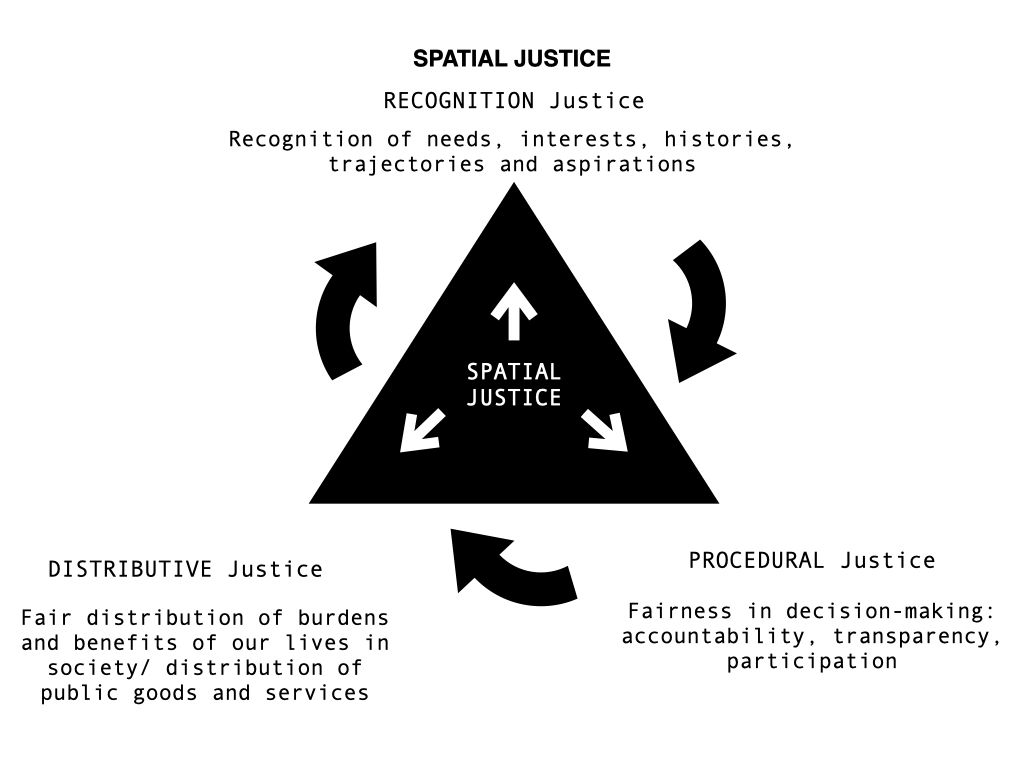
How to read the triangle
The three corners are not independent scores to maximise one at a time. They are dimensions that qualify one another: a plan that distributes resources well but decides everything behind closed doors has not achieved spatial justice, it has relocated the problem from distribution to procedure.
Each corner unpacks into three components — nine in total, set out below — which turn the triangle from a diagram into a working evaluation grid: usable to read a plan, a vision, or a policy against all three dimensions at once.
Download the full conceptual model paper (PDF) →
Rocco, Gonçalves, Dabrowski & López, TU Delft — Horizon Europe UP2030 (grant agreement n° 101096405).
Click each one open.
As an analytical framework, the model allows a structured way of assessing levels of justice while drawing attention to the underlying components that build each dimension.
Distributive
The spatial distribution of the burdens and benefits of human association in cities and communities (Rocco, 2023).
01 Fair Allocation balance · public goods
Fair allocation of burdens and benefits: the material or service provision of public goods, basic services, cultural goods, economic opportunities, and healthy environments.
02 Access opportunity
The ease of reach to a material or service via the enhancement of opportunities. Concerns affordability, availability, connectivity, and the like.
03 Appropriation agency · commons
Appropriating materials or services in a way that transforms them, and the ability to make something “yours” while still sharing and caring for the other. Concerns usage, programming, and design.
Procedural
Procedures and governance of the built environment should be ensured so that they do not reproduce, maintain, or create new inequalities.
04 Democratic Engagement inclusion
Residents included and part of agenda-setting, design, implementation and/or decision-making, with the freedom and trust to negotiate. Concerns the levels of participation.
05 Adaptive Processes innovation
The institution’s flexibility and adaptability to evolving circumstances: incorporating feedback and adjusting policies, practices, and programmes to better align with justice considerations.
06 Responsive Governance mediation · trust
The ability to build trust through negotiation, balancing mediation and direct action, expert knowledge and direct democracy, to uphold justice and legitimise social sustainability.
Recognition
The acknowledgement, validation, respect, and fostering of individual and collective identities, experiences, and cultural expressions — an argument akin to “social differentiation without exclusion” (Young, 1990, p. 238).
07 Validation rights · duties
A form of respect and protection that makes space for acknowledgment within a broader definition of rights and duties, including constitutions, standards, and regulations.
08 Care Practices love · affection
The practices that support and protect groups in marginalised or vulnerable conditions — solidarity networks, mutual aid, and the everyday management of communal resources.
09 Foster Plurality aspirations
An investment in plurality: the transformation of values towards plurality, to foster novel socioeconomic and institutional arrangements rather than a single template.
The triangle is not a checklist.
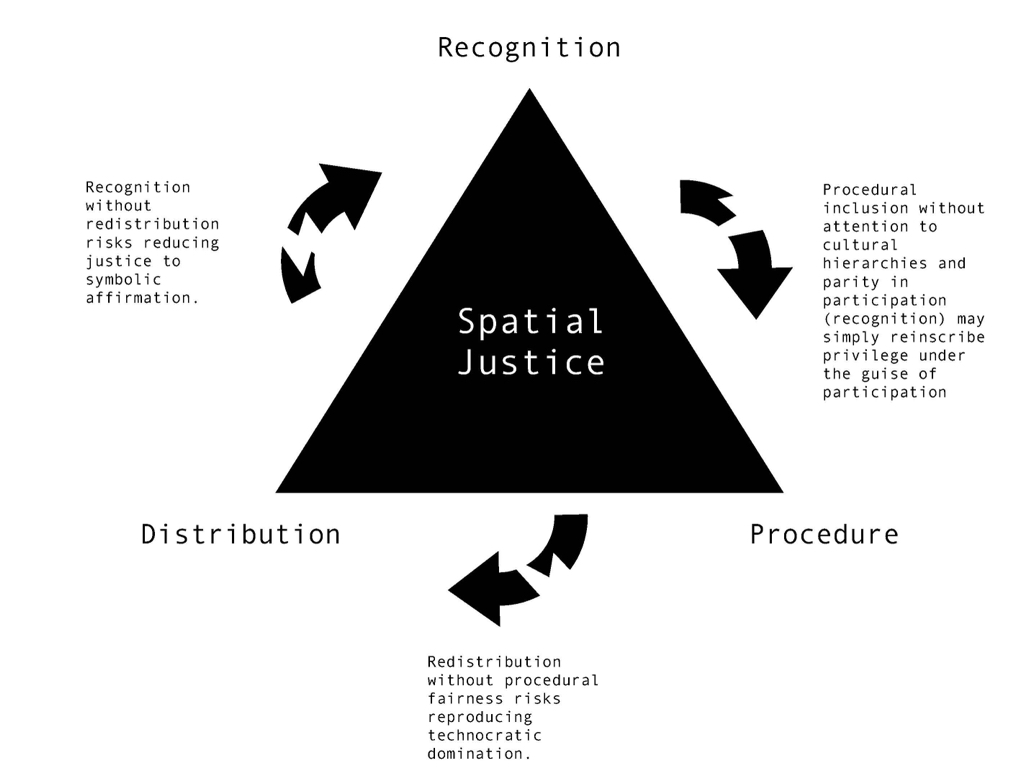
Why pulling the triangle apart fails
Detach any one dimension and the other two stop meaning what they were meant to mean. Distribution without procedure becomes charity administered from above. Procedure without recognition becomes participation that only the already-fluent know how to use. Recognition without redistribution becomes a compliment with no resources behind it.
The arrows in this diagram mark those three failure modes directly — read alongside the text on the page.
Rocco, Gonçalves, Dabrowski & López, TU Delft.
Each dimension changes the meaning and effects of the other two. Spatial justice is produced through their continuing interaction, not through maximising one at the expense of the rest.
Recognition without redistribution risks reducing justice to symbolic affirmation.
Procedural inclusion without attention to cultural hierarchies and parity in participation may simply reinscribe privilege under the guise of participation.
Redistribution without procedural fairness risks reproducing technocratic domination.
The model, tested on a real plan.
In 2024, the Centre applied this model to Belfast’s climate resilience plan, “Resilience Ambitions: A Climate Plan for Belfast” (Belfast City Council, 2020), scoring every highlighted commitment against all nine components. Belfast was one of ten UP2030 partner cities — alongside Lisbon, Granollers, Zagreb, Istanbul, Munich, Rio de Janeiro, Milan, Budapest and Thessaloniki — whose sustainability transition plans the Centre evaluated against this model.
No single component dominated the plan. “Fair Allocation”, “Access” and “Responsive Governance” were discussed with similar frequency, with “Democratic Engagement” close behind — typical of a plan built around service and infrastructure delivery. But “Appropriation” and the Recognition components were comparatively thin, accounting for only around a tenth of the plan’s total highlights.
“Fair Allocation” was the only component to score negatively overall: strong on distributing services, weaker on correcting the disparities underneath them. Recognition scored better than the UP2030 average, largely carried by the plan’s commitment to involving children and young people — but that commitment to “Validation” hadn’t yet been matched by comparable attention to “Care Practices” or “Foster Plurality”. The plan’s overall Justice Readiness Level landed between “Basic” and “Growing”: real engagement with justice, not yet embedded across all three dimensions at once.
How Belfast was scored
Every highlighted commitment in the plan was read against all nine components and rated on the Benchmarking Tool’s five-step readiness scale, from “Low” to “Embedded”. The Belfast plan’s overall Justice Readiness Level landed between “Basic” and “Growing” — real engagement with justice, not yet embedded across all three dimensions at once.
Score a plan yourself with the Benchmarking Tool →
López, Gonçalves, Rocco & Dabrowski (2024). Spatial Justice Evaluation: Belfast. TU Delft Open Publishing.
López, H., Gonçalves, J., Rocco, R., & Dabrowski, M. (2024). Spatial Justice Evaluation: Belfast. TU Delft Open Publishing, on behalf of the UP2030 Horizon Europe project.
Other tools in the Spatial Justice Package.
This model is the analytical spine of the Spatial Justice Package. Other tools in the Spatial Justice Package put it to work: scoring plans, guiding teaching, and moving from diagnosis to design.