
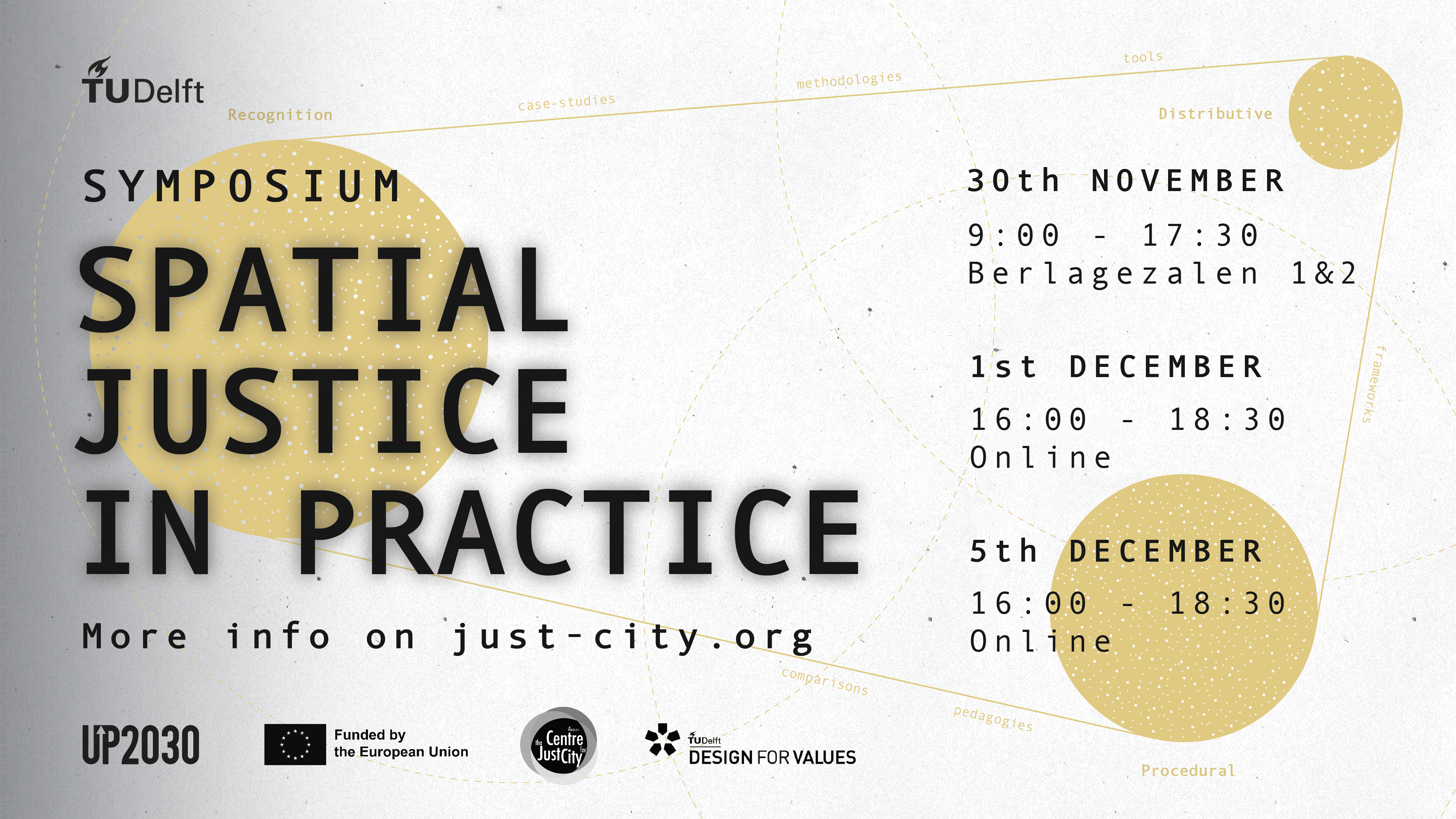
30 November — 5 December 2023 · TU Delft & online
Benchmarking
spatial
justice.
in policymaking, planning & design.
A three-day hybrid symposium convened by the Centre for the Just City to take a step further in the formulation of frameworks, indicators and benchmarks for the practical application of spatial justice. The book of abstracts remains open access.
Held over three days.
All times in UTC
Day 01 · Physical
30
November
2023
09:30 — 17:30 UTC
TU Delft · Bouwkunde
Day 02 · Online
01
December
2023
16:00 — 18:45 UTC
Online · Zoom
Day 03 · Online
05
December
2023
16:00 — 18:45 UTC
Online · Zoom
The symposium Spatial Justice in Practice: Benchmarking Spatial Justice in Policymaking, Planning and Design fostered discussions and exchange that aimed to advance the formulation of frameworks, indicators and benchmarks for the practical application of the concept.
Benchmarking spatial justice involves developing methods and indicators to assess and compare the levels of justice across different regions or communities. It provides a framework for identifying spatial inequalities, evaluating policy interventions, and guiding decision-making processes towards a more equitable and just future.
The symposium was organised by the TU Delft Centre for the Just City within the framework of UP2030, a Horizon Europe project that supports cities in driving the socio-technical transitions required to meet their climate-neutrality targets by leveraging urban planning and design. Spatial justice was one of its main frameworks for policy and project design, implementation, and assessment.
§ Listen — Roberto Rocco’s symposium introduction
§ 02
Three dimensions
of spatial justice.
The Centre’s working framework
I
Distributive
The fair and equitable distribution of the burdens and benefits of our human association — across housing, infrastructure, mobility, environmental risk, and access to public goods.
II
Procedural
The justice found in planning and design procedures. The justice of decision-making processes themselves: who is heard, who participates, and on what terms.
III
Recognition
Social recognition and validation of disadvantaged groups’ specific needs, identities, cultural heritage, and lived experiences — and their political presence in the city.
A hybrid symposium.
Presented in person and online.
Day 01 was held in person at TU Delft. Days 02 and 03 took place online. Authors presented remotely or in the room. Accepted abstracts were presented in oral form during the symposium; selected authors were invited to contribute to a special issue and an edited volume on benchmarking spatial justice.
§ 03
Six themes.
Tracks discussed
-
01
Inclusive urban design & planning
How design choices impact the accessibility, usability, and comfort of spaces for different socioeconomic and cultural groups.
-
02
Equitable infrastructure
The distribution of essential infrastructure — transportation, healthcare, education facilities — and the consequences of disparities.
-
03
Housing justice & gentrification
The effects of housing policies, displacement, and gentrification on marginalised communities, and strategies to mitigate negative impacts.
-
04
Environmental justice
Ways to address disproportionate exposure to environmental hazards and the lack of green spaces in underserved neighbourhoods.
-
05
Community & citizen engagement
The role of community participation in shaping the built environment and promoting spatial justice.
-
06
Policy & planning
The effectiveness of urban policies and planning initiatives in addressing spatial inequalities.
§ 04
The legacy.
Book of abstracts · Open access

PDF · Open access
Book of abstracts.
The full programme and abstract book for the 2023 symposium, downloadable as a single PDF spread for offline reading. Selected papers fed into a special issue and an edited volume on benchmarking spatial justice.
Download PDF ↓§ 05
Convened by.
Eight names · Four institutions
- 01Roberto RoccoTU Delft
- 02Juliana GonçalvesTU Delft
- 03Caroline NewtonTU Delft
- 04Marcin DabrowskiTU Delft
- 05Hugo LopezTU Delft
- 06Andrés MaglioneU. Naples Federico II
- 07Russell SmithWinston-Salem State
- 08Shahryar SarabiUniversity of Utrecht
The conversation.
Archived.
Read the book of abstracts to revisit what was discussed
Download book of abstracts ↓Centre for the Just City · TU Delft · Symposium archive 2023
Three days · Six themes · Eight organisers · One reference