
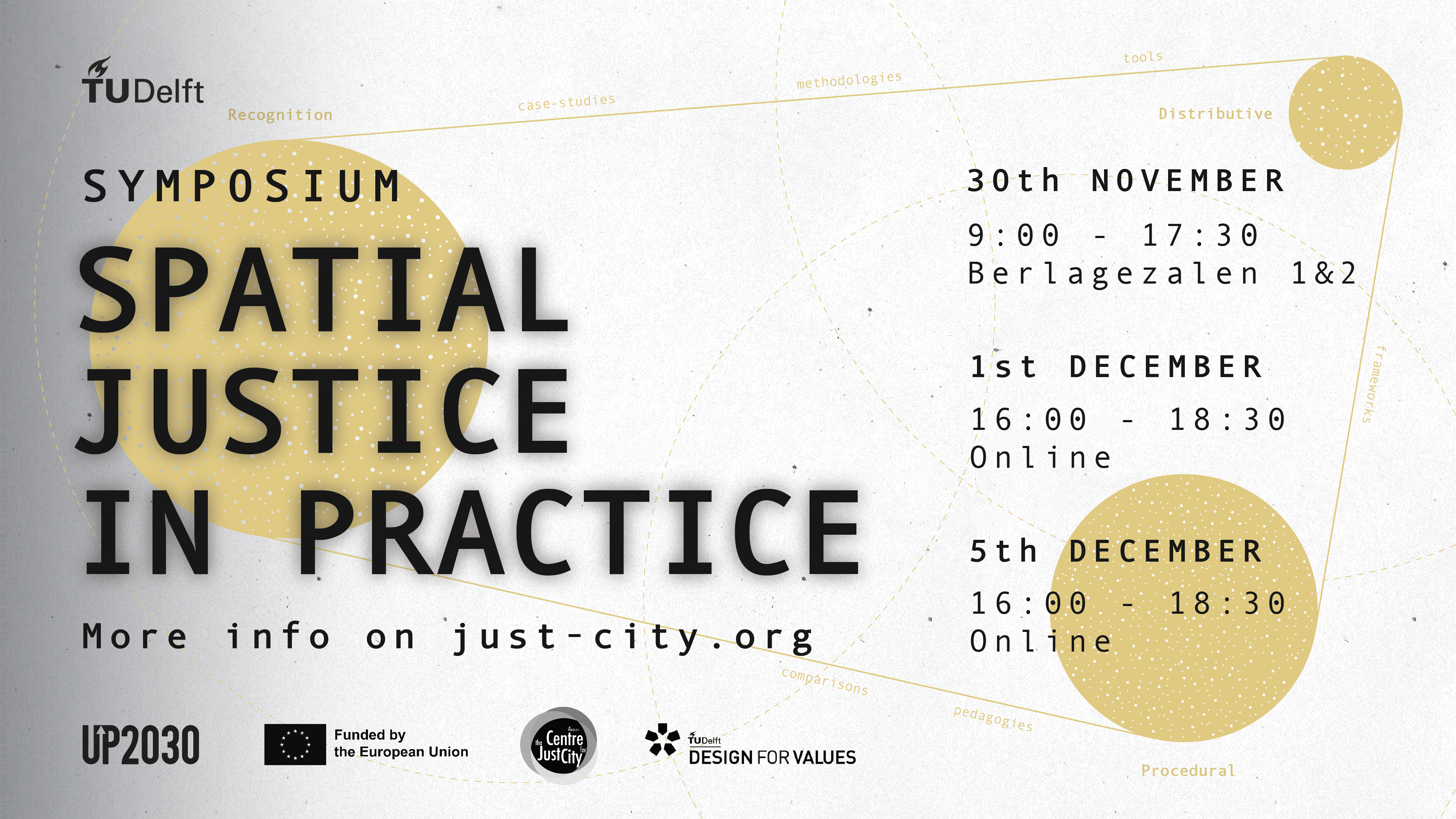
Symposium
Benchmarking Spatial Justice in Policymaking, Planning & Design
NOV 30th, 2023 (PHYSICAL)
9:30-17:30 PM (UTC)
DEC 1st, 2023 (ONLINE)
16:00-18:45 PM (UTC)
DEC 5th, 2023 (ONLINE)
16:00-18:45 PM (UTC)
The Symposium ‘Spatial Justice in Practice: Benchmarking Spatial Justice in Policymaking, Planning and Design’ (30 NOV at TU Delft, 1 and 5 DEC 2023 online) aims to foster discussions and exchange that allow us to take a step further in the formulation of frameworks, indicators and benchmarks for the practical application of the concept.
While a definite definition of Spatial Justice is elusive, at the TU Delft, we conceptualise spatial justice as having three interconnected and mutually reinforcing dimensions: distributive (the fair and equitable distribution of the burdens and benefits of our human association), procedural (the justice found in planning and design procedures, the justice in decision-making processes) and recognition (the social recognition and validation of disadvantaged groups’ specific needs, identities, cultural heritage, and experiences). Spatial Justice is a core dimension of transitions to sustainability, encompassing issues such as climate justice, mobility justice, participation, democracy, access to public goods and more.
Benchmarking spatial justice involves developing methods and indicators to assess and compare the levels of justice across different regions or communities. It provides a valuable framework for identifying spatial inequalities, evaluating policy interventions, and guiding decision-making processes towards a more equitable and just future.
This symposium is organised by the TU Delft Centre for the Just City in the framework of UP2030 https://up2030-he.eu . This Horizon Europe project aims to support cities in driving the socio-technical transitions required to meet their climate neutrality targets by leveraging urban planning and design. It has spatial justice as one of its main frameworks for policy and project design, implementation, and assessment.
The organising committee is composed by:
Roberto Rocco (TU Delft)
Juliana Gonçalves (TU Delft)
Caroline Newton (TU Delft)
Marcin Dabrowski (TU Delft)
Hugo Lopez (TU Delft)
Andrés Maglione (University of Naples Federico II)
Russell Smith (Winston-Salem State)
Shahryar Sarabi (University of Utrecht)
What’s Spatial Justice?
At the Department of Urbanism of the TU Delft, we conceptualise spatial justice using three main dimensions: distributive (the fair and equitable distribution of the burdens and benefits of our human association), procedural (the justice found in planning and design procedures, the justice in the decision-making process) and recognition (the social recognition and validation of disadvantaged groups’ specific needs, identities, cultural heritage, and experiences). Spatial Justice is a core dimension of transitions to sustainability, encompassing issues such as climate justice, mobility justice, participation, democracy, access and more.
Benchmarking spatial justice involves developing methods and indicators to assess and compare the levels of justice across different regions or communities. It provides a valuable framework for identifying spatial inequalities, evaluating policy interventions, and guiding decision-making processes.
This event will be HYBRID, with an option to present online.
Accepted abstracts will be presented in oral form during the symposium. Selected authors may also be invited to contribute to a special issue or edited volume on benchmarking spatial justice.
There is a flat participation fee of 50 euros in case your abstract is accepted for presentation. This fee can be waived for participants from the Global South or students presenting in the students’ track. Online assistance of the symposium for non-presenters is free.
We believe that this symposium will provide a platform for fruitful discussions, knowledge sharing, and collaboration among researchers and practitioners interested in spatial justice. We look forward to receiving your abstracts and welcoming you to the Symposium on Benchmarking Spatial Justice
Download the full programme

Themes
Themes of Interest: We invite abstracts that explore, but are not limited to, the following themes:
- Inclusive Urban Design and Planning: Examining how design choices impact the accessibility, usability, and comfort of spaces for different socioeconomic and cultural groups.
- Equitable Infrastructure: Investigating the distribution of essential infrastructure such as transportation, healthcare, and education facilities, and the consequences of disparities.
- Assessing Housing Justice and Gentrification: Analysing the effects of housing policies, displacement, and gentrification on marginalised communities and potential strategies to mitigate negative impacts.
- Environmental Justice: Exploring ways to address disproportionate exposure to environmental hazards and lack of green spaces in underserved neighbourhoods.
- Community and Citizen Engagement: Highlighting the role of community participation in shaping the built environment and promoting spatial justice.
- Policy and Planning: Evaluating the effectiveness of urban policies and planning initiatives in addressing spatial inequalities.
Symposium Benefits:
- Opportunity to present research to peers, faculty, and professionals.
- Engage in interdisciplinary discussions with fellow students.
- Enhance understanding of spatial justice and its significance in the built environment.
- Publication opportunities in post-symposium proceedings.
Symposium Fees and Grants:Undergraduate students do not have to pay the flat fee of 50 euros. We have unfortunately no grants to help you attend the symposium.
We encourage undergraduate students passionate about contributing to the identification, critical description and assessment of spatial justice in the built environment to submit their abstracts. This symposium provides a nurturing environment for sharing ideas, receiving constructive feedback, and building connections within the academic and professional community.
For inquiries and the organisers. Join us in unravelling the complexities of spatial justice and its role in shaping the future of our built environments.