
Power, Awards, and the Neglected Ground: A Reflection on “Majara” and the Aga Khan Award
Nima Tabrizi
Architect | Urban Researcher+ Stroller
September 4, 2025
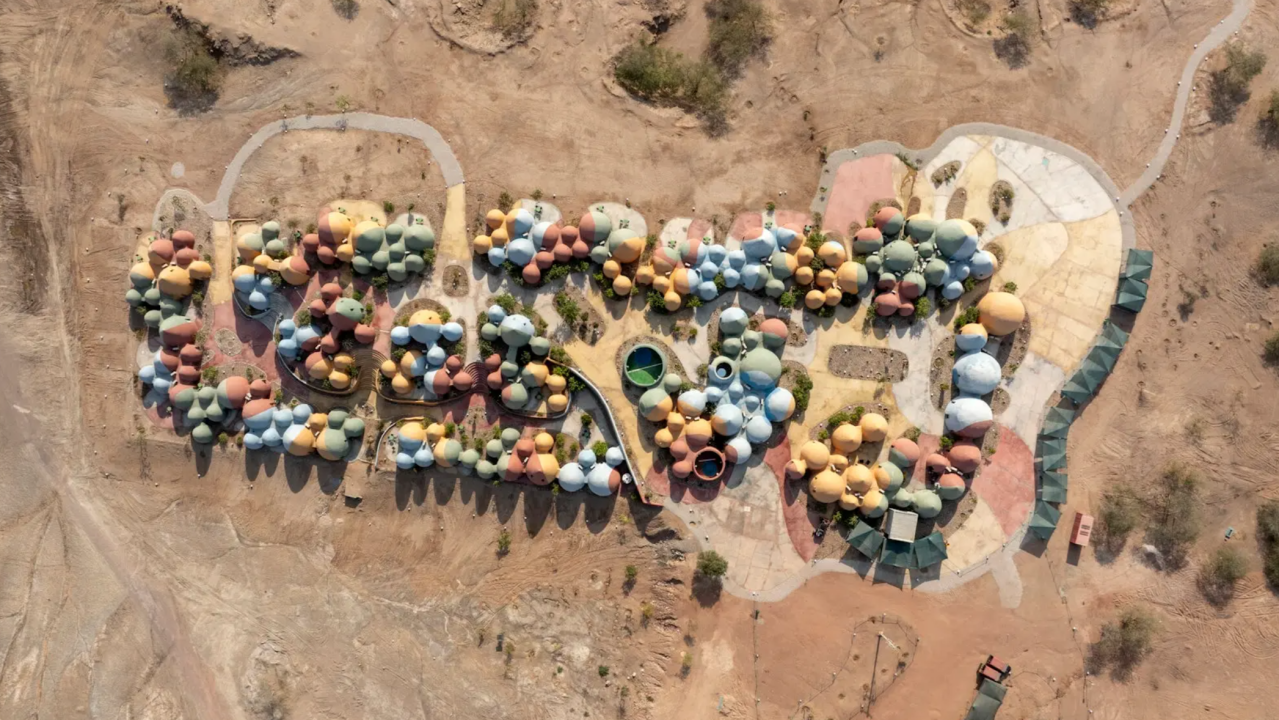
Photo: Majara by ZAV Architects [photo by Deed Studio, taken from the.akdn] // A community-oriented layout for what community?
My fellow Iranian architects have won the Aga Khan Award. Is this good news or not? I ask myself. Perhaps, as an Iranian architect, I should be happy to have heard such news, but what if this happens following dishonesty?
Rightly or wrongly, architectural awards play a vital role in professional and pedagogical discourses. They strongly influence academies, careers, and architectural validation by consolidating legitimacy and visibility not just for the projects but for their designers. Therefore, the more well-known they are, the more influential they become on the narrative through which the built environment is conceived.
There are many architectural awards, among which the Aga Khan Award stands out not only for its financial significance but also for the value system it tries to disseminate among architects and communities, with an emphasis on projects rooted in the Islamic cultural landscape. Consequently, every Aga Khan Award announcement has a crucial impact on how architecture and architects, both in academia and practice, will adaptively redefine themselves in the years ahead. This is why architects must carefully notice and question the outcome of the Aga Khan Award, with concern.
As someone who does not consider himself alienated from the grounded evolution of Iranian architecture of a kind that is — presumably — appealing for the Aga Khan Award, regarding its expressed objectives, I find it necessary to raise some concerns about this year’s award to one of the Iranian projects, asserting that I have no comments on the other awarded projects due to my lack of profound information.
It is said that the jury team is to promote “the solutions that respond to the needs and aspirations of communities” and cherish projects that “serve as catalysts for pluralism, community resilience, social transformation, cultural dialogue, and climate-responsive design” through careful on-site observation of each nominated project.
To respond to community aspirations and serve as a catalyst for pluralism, projects should prioritise authentic and equitable engagement. This means moving beyond a model where locals are reduced to labourers who do not reside on-site and are merely outsiders to their own island’s development by external investors. Moreover, such projects should ensure that the majority of the financial income, if not all, empowers the host community; otherwise, the complex, detached from the urban fabric, would shape heterotopic luxury enclaves for upper-class tourists, with little cultural interaction or dialogue with the local community.
Projects that claim to address resilience and climate responsiveness need to work actively against gentrification and commodification of pristine land, especially in sensitive and endangered environments like Hormuz Island, where, on the one hand, its ecological heritage is being invasively consumed, and on the other hand, its cultural commons and situated knowledge are being disrespectfully neglected.
With regret, drawing on years of personal observation as well as critical study of the project, I argue that the mentioned criteria stand in stark contrast to the reality of the Majara project. This project, initiated by external funding from investors of questionable independence, is marked by an unclear land ownership process, on a valuable natural site distant from residential areas, and led by a team that — despite their probable good intentions — remains detached from local needs. Also, from a more architectural perspective, the project, while visually eye-catching and colourful, appears isolated from its natural and vernacular context and is well-polished with a professional presentation that relies on not-so-accurate narratives about its form’s origin and construction methods.
I would like, once more, to draw public attention to the interrelationship between power and publicity. Projects backed by power, whether institutional or financial, can present and promote themselves more easily, overshadowing grassroots creativity and the true values of locally inspired projects. When architectural projects are placed under the spotlight of prestigious awards that influence architects and architectural movements, for better or worse, jury members and organisations, if sincere in pursuing their socio-environmental values, should refrain from turning a blind eye to whitewashing and instead move toward recognising genuinely impactful efforts. They should consider that their selection could offer visibility and credibility, and by empowering the powered, they play a role in silencing the critical voices.
Leave a Reply